Every group we pick up from Nairobi’s Ronald Ngala Street bus stage asks the same question on the way to Narok: what is the best daypack for safari game drives? What bag should I actually have on my lap during game drives? It matters more than people expect. A bad daypack means dust in your camera, a stiff back after six hours in a Land Cruiser, and a scramble every time a leopard shows up and your binoculars are buried under a jacket.
This guide gives you real numbers, not just brand names. We will cover size, weight limits for bush flights, dust protection, and what actually earns space in your daypack on a Masai Mara or Samburu game drive.
What to Look For in the Best Daypack for Safari Game Drives
Four things matter more than logo or color.
Zipper access. A top-loading sack forces you to dig for your camera while a cheetah is mid-chase. Look for a front or side zip panel instead.
A rain cover or water-resistant base. March to May and November are wet months in the Mara, and dust turns to red mud fast once it rains.
Ventilation on the back panel. Vehicles in Ol Kinyei Conservancy and the Mara Triangle don’t have air conditioning. A mesh back panel keeps sweat off your spine on a hot afternoon drive.
A low profile. Shared game vehicles seat six to seven people. A bulky pack eats into your neighbor’s legroom, and most drivers will ask you to store it under the seat once you’re moving.
What Size Daypack Do You Actually Need?
For a full-day game drive, 15 to 20 liters is the sweet spot. That covers a water bottle, a light rain jacket, sunscreen, binoculars, snacks, and a camera body with one extra lens.
Anything over 25 liters turns into a main bag by accident, and anything under 12 liters won’t fit a 2-liter water bottle plus a jacket once the temperature drops. For context on how cold those early mornings get, read our post on how cold Kenya mornings actually get before you decide how much fleece needs to fit in there.
Backpack vs Sling vs Chest Pack vs Tote
Forum threads on Fodor’s and DPReview argue about this more than any gear list does. Here’s how the four options actually perform on a Kenyan game drive.
| Bag type | Best for | Access speed | Comfort at camp | Indicative price (new) |
|---|---|---|---|---|
| Backpack (15-20L) | Most travelers, camera plus gear | Medium, needs both straps off | Good, doubles as day-trip bag | $30-140 |
| Sling bag | Quick single-camera access | Fast, one strap swing | Awkward for long carries | $25-90 |
| Chest pack | Photographers who shoot from the vehicle window | Fastest, bag stays on your chest | Hot and restrictive back at camp | $60-150 |
| Tote or shoulder bag | Short game drives, minimal gear | Slow, no stabilization on bumps | Poor, swings on rough roads | $15-50 |
Our honest take: a chest pack wins for photographers who need a lens in hand within two seconds of a sighting. But it gets hot fast, and you will not want to wear it at breakfast. For most guests, especially budget travelers doing group safaris with shared vehicles, a 15 to 20 liter backpack with a chest strap gives you the best mix of access and comfort across a full day.
If you are shopping in Nairobi before departure, Decathlon at Garden City Mall stocks the Quechua NH100 20L for around KES 3,500, which is a solid budget option that has held up well on our Amboseli and Samburu trips.
Weight and Size Limits for Bush Flights
If your itinerary includes a bush flight, your daypack choice is not just about comfort. It’s about whether you board at all.
Safarilink and AirKenya both cap total luggage at roughly 15kg per adult passenger, packed in a soft duffel with no wheels and no rigid frame. That 15kg usually needs to include your daypack unless the airline treats it as separate hand luggage, so check when you book. A stiff-framed 45L hiking pack will get flagged at the check-in desk in Wilson Airport every time.
This is the detail most gear roundups skip. A soft-sided 15 to 20 liter daypack that folds flat when empty solves two problems at once: it fits inside your duffel weight allowance on the flight in, and it works as your daily bag once you’re on the ground.
| Route | Distance/flight time | Typical transport | Baggage note |
|---|---|---|---|
| Nairobi to Masai Mara (road) | approx. 270 km, 5-6 hours | Shared shuttle or matatu via Narok | No strict weight limit, but overhead space is tight |
| Nairobi (Wilson) to Musiara airstrip | approx. 45 minutes by air | Safarilink or AirKenya | approx. 15kg total, soft bags only |
| Nairobi to Samburu (road) | approx. 325 km, 6-7 hours | Private transfer or group vehicle | No strict limit, but public buses cap overhead bins |
| Nairobi (Wilson) to Samburu airstrip | approx. 1 hour by air | AirKenya | approx. 15kg total, soft bags only |
Traveling by road from Nairobi keeps you outside the strict 15kg rule, which is one more reason budget groups connecting by matatu or shared shuttle from Narok often bring slightly more gear than fly-in guests.
What to Pack Inside Your Daypack for a Game Drive
Keep it practical. Here’s what earns a spot in ours:
- 2-liter refillable water bottle
- Binoculars, ideally 8×42
- Camera body plus one zoom lens (a 100-400mm covers most Mara sightings)
- Sunscreen, SPF 50 or higher
- A light fleece or windbreaker for the early morning drive
- A dust cover or plastic bag for your camera
- Snacks, since lunch on a full-day drive often happens as a bush picnic
- A printed park map or offline map on your phone
For the complete list covering the rest of your luggage, see our full safari packing list, which works for solo travelers and mixed groups alike.
Dust and Bumps: Protecting Your Gear
Masai Mara’s roads are graded murram, and during the July to October dry season the dust gets into everything. Zip your daypack fully between stops, not just when you leave the vehicle. A simple dry bag or large ziplock inside your pack keeps your camera sensor cleaner than any weather-sealed body will manage on its own.
Bumps matter too. Padded laptop-style sleeves inside your daypack protect lenses better than loose packing cubes, especially on the stretch between Sekenani Gate and Talek, which can get rough after rain.
What to Avoid Bringing on a Game Drive
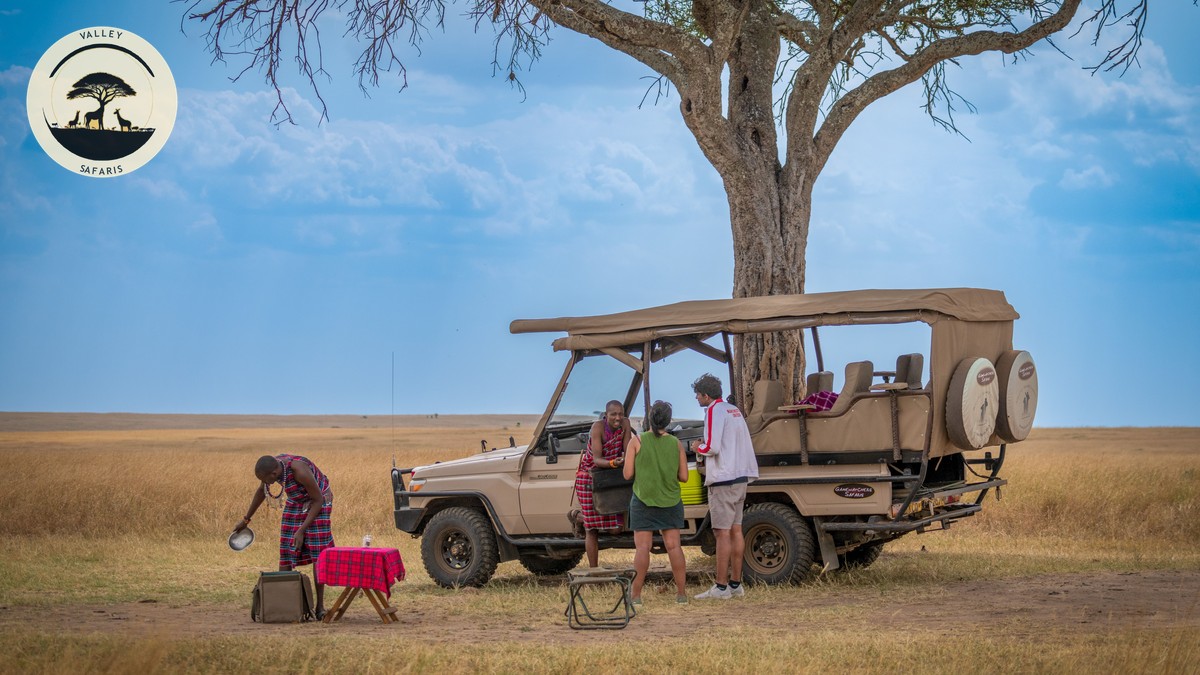
Leave hard-shell camera cases, tripods over 1.5kg, and anything with wheels in your room or tent. Vehicle storage in most Land Cruisers and Land Rovers used across the Mara Triangle and Samburu is limited to under-seat space and the footwell. Bulky items end up on your lap for six hours, which gets old fast. To understand why storage space is so tight, our post on a typical day on safari, hour by hour walks through exactly how a game drive day unfolds, seat by seat.
The Valley Safaris Difference
We run group and budget safaris out of Nairobi, so we see the daypack question play out in real time, at Ronald Ngala stage, at Wilson Airport, and in the vehicle itself. Our guides know which conservancies allow campers to store extra bags at the vehicle depot overnight, and which public campsites near Talek and Sekenani have secure storage for the gear you’re not carrying that day.
We’ve also learned which packs survive a full week of red dust and which fall apart by day three. When you book with us, our pre-trip briefing includes honest, specific advice on what to bring, not a generic checklist copied from a gear website.
Plan Your Trip
Ready to put this daypack to work? Explore our group and budget safari options or get in touch through our contact page to start planning your Masai Mara or Samburu trip with a team that packs these routes every week.